

The private secondaries market surpassed $100 billion in US venture transactions alone in 2025. Global secondary volume is on pace to exceed $210 billion for the full year. Behind these record-breaking numbers lies a clear signal: pre-IPO secondaries have graduated from a niche opportunistic trade to one of the most compelling allocation strategies in private markets today.
For institutional investors, family offices, and qualified individuals, the case for pre-IPO exposure has never been stronger. Companies are staying private through their highest-growth phase, exit windows remain cyclical, and the infrastructure for accessing private company shares—particularly through Secondary SPVs—has matured to a point where institutional-quality execution is available to a much broader set of investors.
What Are Pre-IPO Secondaries—and Why Do They Matter Now?
Pre-IPO investing means acquiring equity in a private company before it lists on a public exchange. In 2026, the term increasingly describes secondary transactions—buying existing shares from current holders such as employees, founders, and early-stage investors—rather than participating in a new primary financing round. Access to late-stage companies increasingly happens before listing through SPVs, secondary deals, and other structured vehicles.
This distinction is important for investors. A secondary purchase transfers economic exposure from an existing shareholder to the buyer—often at a moment when the company has de-risked significantly compared to its early-stage days. The buyer gains exposure to a business with proven revenue, established market position, and a plausible path to a liquidity event, while the seller gets liquidity they may urgently need. It is, in many cases, a transaction where both sides of the table walk away better off.
The Numbers: A Record-Breaking Market
The scale of the private secondaries market has grown dramatically—and the trajectory shows no sign of slowing. Several independent data sources confirm that this is not a cyclical blip but a structural shift in how private markets operate.
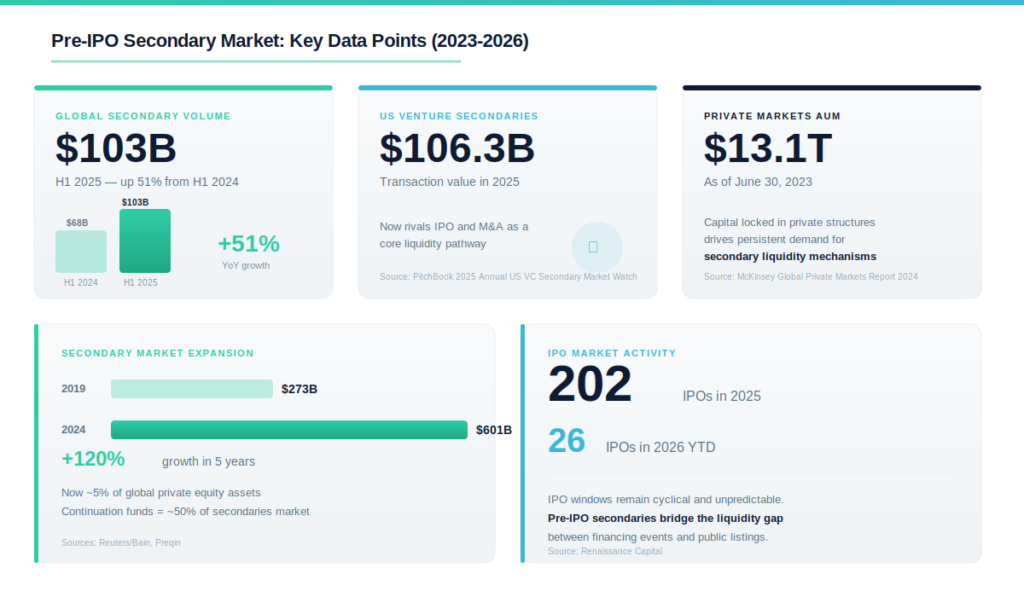
According to the Jefferies H1 2025 Global Secondary Market Review, total secondary market transaction volume reached $103 billion in the first half of 2025 alone—a 51% increase from $68 billion in H1 2024. The full-year 2025 market is estimated to exceed $210 billion. Jefferies’ February 2026 review confirmed 2025 as another record-breaking year for the asset class.
The PitchBook 2025 Annual US VC Secondary Market Watch estimates US venture secondary transaction value reached $106.3 billion in 2025, making secondaries a liquidity channel that now rivals the scale of IPOs and M&A. The PitchBook–NVCA Venture Monitor provides additional context on how secondary activity has evolved as a core liquidity tool within the broader venture ecosystem.
McKinsey’s Global Private Markets Report places total private markets AUM at $13.1 trillion as of June 30, 2023, even as fundraising activity slowed (full report PDF). With $13 trillion locked in private structures, the demand for secondary liquidity mechanisms isn’t just growing—it is structurally embedded in the market.
A Reuters report on Carlyle’s $20 billion secondaries fundraise cited Bain analysis showing the global secondary market expanded from $273 billion in 2019 to $601 billion in 2024—a 120% increase in five years, now accounting for roughly 5% of global private equity assets. Preqin’s Secondaries in 2025 analysis notes that continuation funds now represent almost half of the secondaries market. When the world’s largest allocators are building dedicated secondaries programmes at this scale, the opportunity set speaks for itself.
Renaissance Capital’s IPO statistics show 202 IPOs in 2025 and 26 IPOs in 2026 year-to-date. IPO windows remain cyclical and unpredictable—which is exactly what makes pre-IPO secondaries so valuable as a liquidity bridge. Investors who position themselves before the listing capture upside that public-market-only investors never see.
The Investment Case: Why Pre-IPO Secondaries Deserve a Place in Your Portfolio
The investment thesis for pre-IPO secondaries is built on structural advantages that have only strengthened as the market has matured. As with any private markets allocation, risks exist—but for investors who approach the asset class with discipline and the right infrastructure, the reward potential is substantial.
The Opportunities
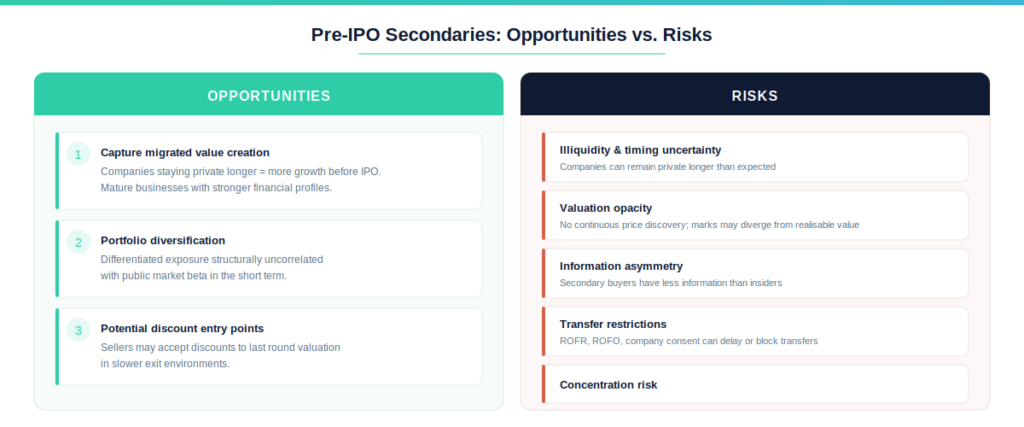
Capture the growth that used to happen in public markets. Two decades ago, companies like Amazon and Google IPO’d relatively early in their growth curves. Today, companies routinely stay private through their highest-growth phases. For investors, this means the most significant value creation now happens before listing. Pre-IPO secondaries provide a way to access that growth—with exposure to mature businesses that have already demonstrated product-market fit, substantial revenue, and clear unit economics.
Enter at a more favourable risk-return point than early-stage venture. Unlike seed or Series A investments, late-stage pre-IPO secondaries target companies that have already navigated the highest-risk phases of building a business. The company exists, the product works, and revenue is growing. The primary question is timing and valuation—not whether the business will survive.
Access potential discount entry points. In slower exit environments, sellers—employees needing liquidity, funds facing duration pressure, or LPs rebalancing portfolios—may accept meaningful discounts to the last primary round valuation. For buyers, this creates an opportunity to acquire high-quality exposure at prices that already build in a margin of safety.
Diversify across uncorrelated return streams. Pre-IPO holdings do not reprice with daily market volatility. For portfolios seeking differentiated exposure that is structurally uncorrelated with public equity beta in the short term, a measured allocation to late-stage private companies can improve overall portfolio construction.
The Risks—and How to Manage Them
Pre-IPO secondaries are not risk-free, and investors should size allocations accordingly. The key, however, is that each of these risks can be substantially mitigated through disciplined structuring, experienced deal management, and working with a trusted SPV provider.
Illiquidity and timing uncertainty. Companies can remain private longer than anticipated. Mitigation: underwrite multiple exit pathways (IPO, tender, M&A, secondary sale of the SPV interest) and model realistic hold periods before committing capital.
Valuation opacity. Private marks rely on financing rounds or negotiated prices rather than continuous price discovery. Mitigation: benchmark entry price against comparable public multiples, recent secondary market pricing, and multiple scenario analyses.
Information asymmetry. Secondary buyers typically have less information than insiders. Mitigation: work with an SPV manager or platform that conducts rigorous diligence on cap table rights, liquidation preferences, and protective provisions before every transaction.
Transfer restrictions. ROFR, ROFO, and company consent provisions can complicate transactions. Mitigation: screen for transferability early and work with experienced legal counsel who understand the mechanics.
Concentration risk. Single-name, single-asset exposures require honest fee structures. Mitigation: ensure the SPV economics reflect concentration risk, and diversify across multiple pre-IPO positions where possible.
Why Secondary SPVs Are the Proven Structure for Pre-IPO Investing
A Secondary SPV is a dedicated special purpose vehicle created to acquire a specific block of shares in a specific private company. It has become the dominant structure for pre-IPO secondary transactions because it elegantly solves coordination problems for every party involved: the company, the seller, and the investors.
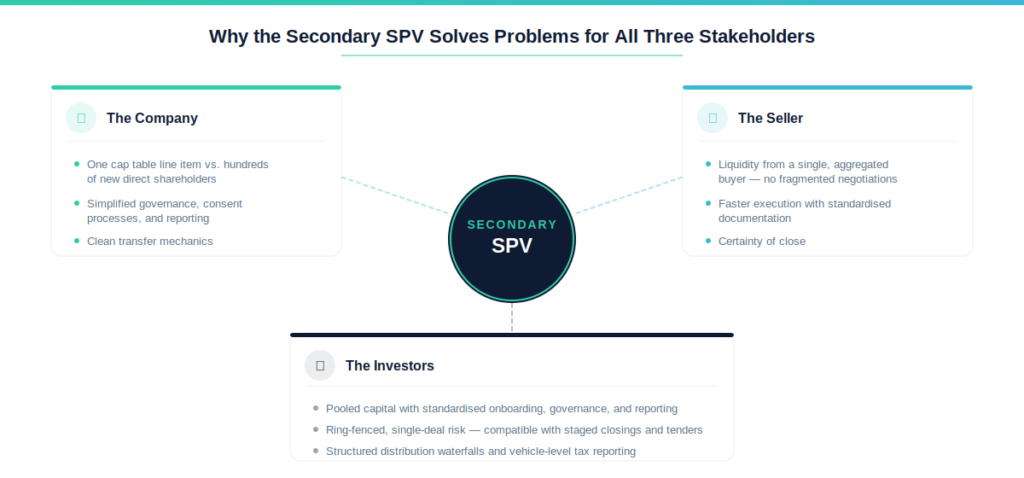
For investors specifically, the SPV structure offers several practical advantages that make pre-IPO exposure operationally viable: pooled capital lowers minimum ticket sizes, standardised documentation reduces legal friction, ring-fenced single-deal risk keeps exposure clean, and vehicle-level administration simplifies tax and reporting. For syndicate leads and fund managers running deal-by-deal programmes, the SPV is the operational backbone that makes pre-IPO transactions feasible at scale.
The structure has also proven itself across thousands of transactions globally. Whether the deal involves an employee liquidity block, a VC fund portfolio sale, or participation in a company-led tender offer, the Secondary SPV provides a tested, repeatable framework that institutional and individual investors alike can rely on.
How to Structure a Pre-IPO Secondary SPV
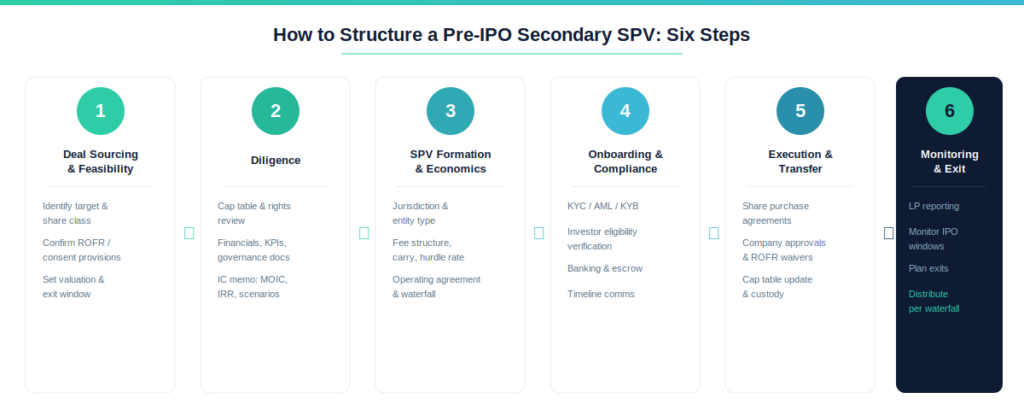
The structuring process follows six stages. While each step is manageable for experienced operators, the regulatory, legal, and compliance requirements mean that working with a specialist SPV platform is strongly recommended—particularly for investors and syndicate leads who want to focus on deal origination and investor relations rather than back-office mechanics.
Step 1: Deal Sourcing and Feasibility
Identify the target company and share class. Confirm transferability by reviewing ROFR/consent provisions. Set indicative valuation parameters and define the target exit window. Screen for regulatory or contractual blockers early.
Step 2: Diligence
Build a focused diligence pack: cap table and rights summary, governance documents, available financials and KPIs, and any material legal or regulatory issues. Prepare an investment committee memo with base, upside, and downside scenarios covering MOIC, IRR, and time-to-liquidity.
Step 3: SPV Formation and Economics
Choose the jurisdiction and entity type. Define fee structure (management fee, carry, hurdle rate) appropriate for a single-asset, concentrated exposure. Draft the operating agreement, subscription documents, and risk disclosures. Structure the distribution waterfall—splitting equity proceeds from debt proceeds where applicable.
Step 4: Investor Onboarding and Compliance
Execute KYC/AML/KYB checks. Verify investor eligibility under the applicable exemption (Reg D accredited investor, FCA financial promotion exemptions, or equivalent). Establish banking and escrow mechanics. Communicate timelines, conditions, and any allocation risks clearly.
Step 5: Purchase Execution and Transfer
Sign share purchase agreements. Obtain company approvals and ROFR waivers. Complete the transfer and update the cap table. Address any share legends, custody arrangements, and voting proxies.
Step 6: Monitoring and Exit Management
Maintain a regular reporting cadence to LPs. Monitor IPO windows, tender offer opportunities, and M&A activity. Plan exit routes across multiple scenarios: IPO with post-lockup sell-down, company tender, strategic acquisition, or secondary sale of the SPV interest itself. Execute distributions per the waterfall upon realisation.
| Need expert support structuring your Secondary SPV?Getting the legal, compliance, and operational infrastructure right is critical to a successful pre-IPO secondary transaction. Quoroom offers an FCA-regulated UK SPV solution with extended payment infrastructure and institutional-grade compliance standards—handling everything from entity formation and investor onboarding to settlement and ongoing reporting. Learn more about Quoroom’s legal structures and SPV capabilities here.→ Book a call to discuss your Secondary SPV |
Secondary SPVs in Practice: Three Common Deal Patterns
Pattern A: Employee Liquidity Block in a Late-Stage Company
A late-stage fintech delays its IPO by 18–24 months. Employees holding vested options or RSUs seek partial liquidity; the company wants to avoid fragmenting its cap table. The SPV manager aggregates multiple employee sellers, secures company approval conditioned on consolidation into a single vehicle, pools investor capital, and acquires shares at a negotiated price—often at a discount to the last primary round. The SPV holds through IPO and sells in tranches post-lockup. Key diligence point: common versus preferred share rights and the position within the liquidation preference stack can materially affect investor outcomes.
Pattern B: VC Fund Portfolio Sale for Duration Management
An early-stage VC fund approaching the end of its term needs to return capital to LPs but holds positions in companies that have not yet reached an exit. The SPV purchases a defined block of shares from the fund—frequently at favourable pricing driven by the fund’s urgency—navigates the ROFR/consent process, and accepts a longer hold period. Exit may occur via a subsequent tender offer or the company’s eventual IPO. Key diligence point: tender offers can provide earlier-than-expected liquidity but are frequently capped and pro-rated.
Pattern C: Tender Offer Participation with Partial Fill
A company-led tender offer provides limited liquidity to employees and early shareholders. The SPV forms quickly to meet the tender deadline. Investor commitments are conditional on allocation. The SPV receives a partial fill—for example, 60% of the requested amount—and returns excess capital to investors. Key structuring point: model partial fills explicitly and ensure the SPV platform can handle conditional commitments and rapid capital returns without fee drag.
Regulatory Considerations
This section is informational only and does not constitute legal advice. Consult qualified counsel for your specific jurisdiction and facts.
The regulatory landscape for pre-IPO secondary SPVs spans multiple jurisdictions and exemption frameworks. Navigating these requirements correctly is non-negotiable—and a key reason why investors and deal sponsors benefit from working with an experienced, regulated SPV platform. Quoroom’s FCA-regulated infrastructure is purpose-built for this purpose, providing compliant structuring across UK and international investor bases.
United States: Regulation D and Rule 144
Most private SPV offerings in the US rely on Regulation D exemptions (see also SEC offering statistics), typically targeting accredited investors (net worth exceeding $1 million excluding primary residence, or income exceeding $200,000 individually / $300,000 jointly for the prior two years).
Post-IPO Liquidity: Faster Than You Might Think
A common concern among pre-IPO investors is that shares remain locked up for months after an IPO. While in relations to the US issuers, Rule 144 holding period requirements do apply—generally six months for reporting issuers, one year for non-reporting issuers—it is important to understand that these are regulatory maximums, not the only liquidity pathway.
In practice, SPVs holding pre-IPO shares often gain liquidity significantly faster than the standard lockup timeline suggests. One of the most common mechanisms is through underwriter-facilitated sales. When an IPO is underwritten by a major investment bank, the underwriters typically manage the orderly distribution of shares—including shares held by pre-IPO investors and SPVs. Underwriters may facilitate block trades, secondary offerings, or coordinated sell-down programmes that allow pre-IPO holders to realise liquidity well within or immediately following the lockup period, depending on market conditions and the terms negotiated with the issuer.
Additionally, some IPO lockup agreements include early release provisions that allow the underwriter to waive the lockup for certain holders—particularly when share demand is strong and an orderly distribution can be facilitated without disrupting the market price. In high-demand IPOs, it is not uncommon for pre-IPO holders to receive partial or full lockup releases within 30–90 days of listing.
For SPV investors, this means the path from IPO to realised liquidity is often shorter and more structured than the headline “6-month lockup” implies. A well-structured SPV with experienced management will actively engage with underwriters to optimise the timing and execution of post-IPO distributions.
United Kingdom: Financial Promotion and Investor Categories
Investment communications are subject to the financial promotion restriction under the FSMA 2000 (Financial Promotion) Order 2005 unless an exemption applies. Common exemptions for private markets transactions include communications to investment professionals (Article 19) and to high net worth companies, unincorporated associations, and trusts (Article 49). The FCA Handbook (PERG 8) provides further guidance. Working with an FCA-regulated platform ensures that financial promotions, investor categorisation, and distribution comply with applicable requirements.
EU/UK: AIFMD—Why a Properly Structured SPV Is Not a Fund
ESMA’s guidelines on key concepts of the AIFMD set out the criteria for when a vehicle may be classified as an Alternative Investment Fund (AIF)—including features such as raising capital from multiple investors, investing in accordance with a defined investment policy, and pooling capital for the benefit of those investors. For managers considering a Secondary SPV, this is a critical question: if the vehicle is classified as an AIF, it triggers a full regulatory regime including authorisation, capital requirements, depositary obligations, and ongoing reporting.
The good news is that a single-deal Secondary SPV, when properly structured, typically falls outside the AIFMD definition. The key factors that distinguish a one-off deal SPV from a fund include: the vehicle is established to acquire a specific, pre-identified block of shares in a single company; there is no defined “investment policy” involving discretionary allocation across multiple assets; and the manager does not exercise ongoing portfolio management discretion of the kind associated with fund management. The SPV is, in substance, a co-investment wrapper—not a managed fund.
However, the line between an SPV and an AIF can become blurred if the structuring is not handled carefully—particularly where a manager runs repeated programmes of SPVs or retains broad discretion over investment decisions. This is precisely where working with an experienced, regulated provider matters. Quoroom’s legal structures are specifically designed to ensure that each Secondary SPV is structured as a standalone, single-purpose vehicle that satisfies the criteria for falling outside the AIFMD perimeter—giving deal sponsors and investors confidence that the vehicle operates within a clear regulatory framework without triggering fund-level obligations.
Best Practices for Investors Evaluating Pre-IPO SPVs
- Clarify share class and rights. Understand the liquidation preference position, conversion mechanics, voting rights, and protective provisions before committing capital.
- Underwrite multiple exit pathways. Model IPO, tender offer, M&A, and secondary sale of the SPV interest. No single exit route should be assumed.
- Stress-test valuation and timing. Evaluate entry price relative to the last round, comparable public multiples, and realistic time-to-liquidity. Factor in post-IPO lockup constraints.
- Scrutinise fee alignment. Single-asset, concentrated exposures should carry fee structures that reflect concentration risk rather than mirroring diversified fund economics.
- Work with a regulated SPV platform. The legal, compliance, and operational complexity of secondary transactions demands institutional-quality infrastructure. An FCA-regulated provider like Quoroom handles entity formation, investor onboarding, payment processing, and reporting—so deal sponsors can focus on origination and returns.
| Ready to explore Pre-IPO opportunities?Quoroom’s platform hosts a curated pipeline of pre-IPO Secondary SPV opportunities across late-stage technology, fintech, and high-growth sectors. If you’re an investor looking to access pre-IPO secondaries through a regulated, institutional-quality structure, we’d welcome the conversation.→ Express interest in Pre-IPO SPV opportunities on Quoroom→ Book a call to discuss your investment goals |
Frequently Asked Questions
Not necessarily. Pre-IPO investing typically targets later-stage private companies and is frequently executed through secondary purchases of existing shares, rather than primary financing rounds. The risk profile is generally more moderate than early-stage venture: you’re investing in companies with proven products and revenue, where the primary uncertainty is around timing and valuation at exit.
A Secondary SPV (Special Purpose Vehicle) is a dedicated legal entity that pools investor capital to acquire existing shares in a private company from current shareholders. It consolidates multiple investors into a single cap table entry, simplifying governance for the target company while providing structured, compliant access for investors. It is the most widely used vehicle for pre-IPO secondary transactions globally.
Liquidity typically arrives faster than the headline lockup period suggests. While contractual lockups of 90–180 days are standard, SPV holders often gain access to liquidity through underwriter-facilitated block trades, secondary offerings, and coordinated sell-down programmes—sometimes within weeks of listing in high-demand IPOs. A well-managed SPV will actively engage with underwriters to optimise the timing of post-IPO distributions for its investors.
Eligibility depends on jurisdiction and the specific offering exemption. In the US, most SPV offerings target accredited investors under Regulation D. In the UK, financial promotion exemptions shape distribution to investment professionals and qualifying entities. Quoroom’s platform ensures investor eligibility is verified as part of its regulated onboarding process.
Pre-IPO secondary transactions involve complex legal, compliance, and operational requirements across multiple jurisdictions. An FCA-regulated platform like Quoroom provides institutional-grade infrastructure for entity formation, investor onboarding (KYC/AML/KYB), payment processing, and ongoing reporting—reducing risk for both deal sponsors and investors. Learn more about Quoroom’s legal structures.
Not when it is properly structured. A single-deal Secondary SPV that acquires a pre-identified block of shares in one company, without exercising ongoing discretionary portfolio management, typically falls outside the AIFMD definition of an Alternative Investment Fund. The critical factor is the structuring: working with an experienced provider like Quoroom ensures each SPV is designed as a standalone, single-purpose vehicle that stays outside the AIFMD perimeter—avoiding fund-level regulatory obligations.